
I’ve been away from home this summer trying to figure out whether the world of academia has a place for me. Over the past weekend, I’ve been feeling a bit under the weather. A friend made the trek across the city to bring me some much needed sustenance – a cute book and muffins.
The Queen Of Jasmine Country has a really attractive cover, which is already a big plus point. You know how they always say don’t judge a book by a cover? I say, bollocks.
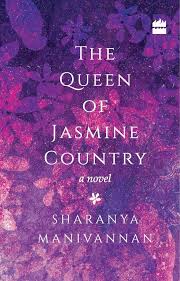
You can gauge a lot from a cover and the title. For instance, whether you want to pick it up at all. But I suppose picking up hard bound copies is a rather quaint habit. I suppose I’m being rather whimsical, but it usually does me good to judge a book by what’s on the cover and avoid what’s behind or nestled in the jacket.
The blurb in most cases, for reasons I can’t quite understand is so shoddily done! It’s either a condensed summary of a body of work that somehow makes it sound dull or worse, a summary of just a part of the book that caught the fancy of whoever wrote the blurb. It almost always fails to capture the essence of the work or convey the salient points without tainting the experience. My unsolicited advice for the uninitiated: judge a book by it’s cover, the first paragraph and the first chapter.
This one is about one of my favourite gods, Andal. Accordingly to ancient Tamil lore, she is thought to have emerged from a flower, untainted. She is known for the 30 poems she composed in the season of Margazhi, the Tamil month from mid-December to mid-January till the harvest festival, Pongal. During this month at the age of 17 she was observing a ritual – the Pavai Nombu to pray for love. She was intent on marrying the Lord and wanted no one else.
Unlike many old forgotten myths, this tradition persists even today and her poems have transcended her intentions. All across Tamilnadu, every Marghazi, temples and households observe the custom of reciting Thirupavai, the poem corresponding to that day.
As the author Sharanya Manivannan puts it, a lot is known about the goddess Andal but little is known about the young girl, Kodhai found in a grove and brought up by a garland weaver-poet in the small town Pudhuvai, whose desire for the Lord is so deep and profound.
The story is told from Kodhai’s perspective and we receive some insight into the world women lived in that age, and the turmoils faced by her. The translation and incorporation of the Thiruvpavai especially the first one – Marghazi Thingal (It begins on the first Monday of the season) is absolutely on point and moving. One of the more nuanced skills in translation is to transcend beyond words, while using the right ones, to capture the intended feeling in the context of a work and this has been on point.
The known features of her short lived life has been gracefully traced and it’s been a very pleasurable read to curl up with this Sunday.
I went back and listened to some old recordings of Thirupavai and I miss coercing my grandmother to sing them for me in her sweet, melodious voice. Perhaps, I should get her to record some.
 Sankalpa Venkatraghavan