
If you’ve ever had an enthusiastic math or physics teacher, then the importance of doing ‘back of the envelope calculations’ is likely to have been overemphasized and illustrated in great detail. If you’ve not had the pleasure, here’s a classic example.
Find the height of the building you are in, and it’s total weight. State your assumptions clearly.
These were my favourite sort of questions in school, open-ended, and all you need is for your logic to make sense. I’d approach it by saying, my apartment is 15ft high, and there are 4 apartments in total. Assume thickness of the ceiling is 1ft, and the same holds for the terrace. There are no houses on the ground floor, and the first floor is 20ft high. So the total height should roughly be 20 + 15 x 4 + 4 = 84ft. To calculate the mass, an important question of standard arises – what is the weight of 1kg of concrete?
The International Bureau of Weights and Measures (it is in France) actually housed a prototype of what 1kg was until recently when the definition itself was changed to be based upon some constants of the universe (yes, they exist). I digress, the point of all this is to note the importance of having standards and references so that if I calculate the weight of my building and you calculate the weight of yours, we can make sensible statements like my building weighs twice as much as yours.
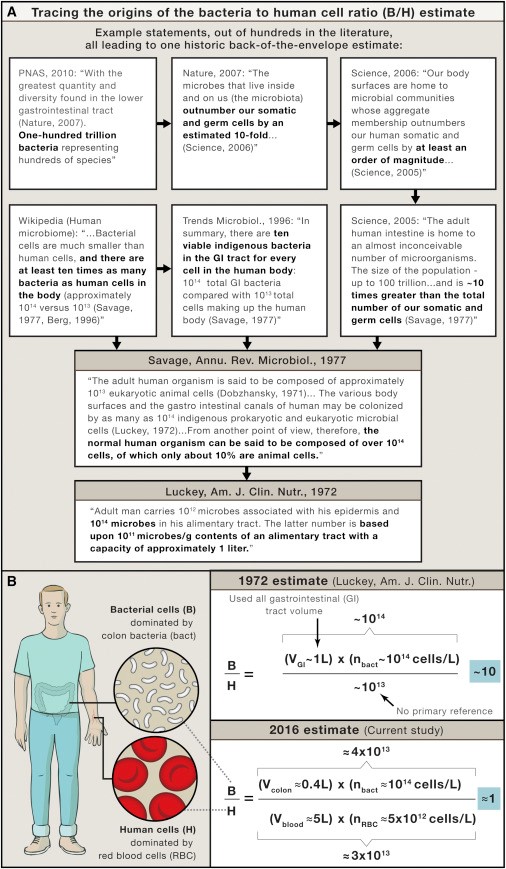
Citation tracking is genuinely an art, especially in biology. When you want to know the value of a parameter to use, more often than not, the citation trail will lead to an old paper with a number, and you just won’t know where it came from! This is a story of how a whole field of study of human microbiota has been using an inaccurate number and where citation tracking led us.
Researchers in the field claimed that the ratio microbes that live in cells to the total number of cells are a shocking 10:1. That is, there are ten times more microbes that make up your body than cells. As we followed the trail, we hit upon the actual back of the envelope calculation, which probably never had the idea that its value would stretch so far. Since the climax has been ruined by way of introduction, the calculation, although sound, did not take some key factors into consideration.
It is first assumed that the microorganisms are primarily found in the colon and those from other regions like the skin, is negligible. The mistake in the initial calculation was that the volume of the colon was taken to be the volume of the alimentary canal, which is around three times longer. This implies, what was a 10 fold difference is closer to an equal proportion of bacteria and cells.
That would be a pretty big difference if you were planning to use these numbers to estimate the total amount of DNA present in a human body, for instance. I think it is crucial to nitpick about values chosen from literature and convince oneself that they were estimated or calculated using assumptions that make sense.
Reference: https://www.cell.com/cell/fulltext/S0092-8674(16)00053-2
 Sankalpa Venkatraghavan
>Find the height of the building you are in, and it’s total weight.
Already with that #guesstimates prep hmmm
LikeLike